We all want tremendous growth and health from the trees and shrubs in our landscapes. And now is the time to make sure your trees have the nutrients they need for a good growing season. Fertilizer provides nutrients needed to boost plant, shrub, and tree growth. There are several ways to go about fertilizing your trees and shrubs. There are granular surface fertilizers as well as liquid fertilizers. At AA Tex Lawn, we prefer to push liquid fertilizer into the soil around the drip line of the tree. This is known as deep root feeding.
Deep root feeding is a process by which we inject fertilizer directly into the ground at the root zone of the tree or shrub using a root feeder tool attached to a spray hose. It not only puts the product at the root zone (where it is most effective) but also aerifies the soil and stimulates root growth. With the hard clay soil that we have in the piedmont section of North Carolina, absorption of granular fertilizers into the root system of the tree can sometimes be hindered by compaction of the soil… particularly in times of drought or reduced rainfall. This is where deep root feeding comes in. The fertilizer is released directly into the root zone. In addition, the holes left from deep root feeding allow additional water to reach the roots of the tree or shrub. The benefits to the tree are numerous.
Deep root feeding is a standard process for tree care, but we have adopted it to use on ornamental trees and shrubs, too.
No matter whether you prefer to use a granular or liquid fertilizer, be sure to follow the manufacturer's instructions. Applying too much fertilizer can be harmful for your trees whereas applying too little is ineffectual. Or just let a professional handle it for you. Contact our office if you have any questions or if you'd like us to help you with the process. We should begin our deep root feeding in the late January/February timeframe.
Thanks,
The AA Tex Lawn Team
Thursday, January 12, 2012
Tuesday, December 20, 2011
BEEN THERE, DONE THAT, GOT THE T SHIRT… AND THE BLESSING OF SERVING
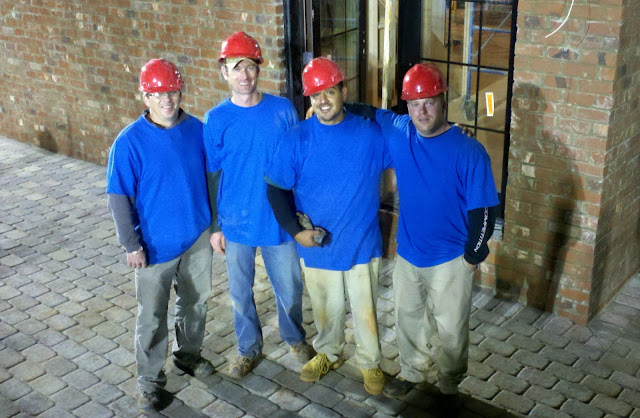
Last week our company got an unexpected invitation. We were informed that Extreme Makeover: Home Edition was in Lincolnton and needed landscape volunteers. For quite a few of us, the answer was a resounding, YES! WE WANT TO PARTICIPATE. Where do we sign up? So the excitement began. We looked up the family and it is an amazing story of giving and sacrifice to say the least. This family has fostered over 30 children over the years. We talked about what shift was best for us, signed up for a time, and discussed how we would meet and get there. The anticipation was building. We checked out the news channel websites all week to follow the progress. Finally, Thursday night arrived and we headed off to our great adventure. As we met, grouped up, and started out we were worried that with this build-up, we might be disappointed. So we were eager to get there and find out what it was like.
While I am not going to get into the detailed descriptions of the build, (you need to watch the episode to get that and I do not want to spoil it), I will describe the adventure. When we arrived, we were met on the road in by Police officers helping us get to where we needed to be. Big bright spotlights filled the perimeter of the parking lot and lit up the evening sky like a big city. From there we had to go and register. This is where the t-shirt comes in. They gave us the official Extreme Makeover: Home Edition t-shirt. That was our ticket in. And as an added bonus, we got real hard hats to wear (although we did have to give that back when we left). Quite honestly we were kind of like kids at Christmas. Once the necessary paperwork was done, and after 2 trips back to the truck to get gloves, etc, we headed in.
You could not see the build site from the road. You had to walk through fenced areas, through neighboring yards and behind fencing and screening to get to the site. Appropriately enough there was a walkway between other houses that ended at a tent we had to walk through to get to the house. You could not see anything until you were past the tent. And there it was. An almost completed house, standing where another had been only Monday. It was dried in, windows in, roof on, siding and brick work completed, rear patio and wall only hours away from completion. It was a sight to behold. We had all looked at the video of the original house being demolished on Monday. Here it is 48 hours later and this new house is near completion.
Once we walked through the back gate, there was another amazing sight, people everywhere, working. Some were working on the patio. Others were working on the landscape. There were people up on the roof working, people inside the house laying tile and doing finishing work. Machines were moving carrying supplies and dirt, gravel, and whatever was needed. Generators running, large light carts everywhere lighting up the area. Carpenters, landscapers, tile installers, electricians, basically any occupation used to build a home was there working. Everybody had a job to do and it had to be done in a matter of hours.
The five of us quickly jumped to it, trying to figure out where to start and where we were needed. We were split into two groups. Some helped install some of the paver patio and walkway, some planted some trees and shrubs, dug bed lines, and did grading. Now we’re at the part that was most impressive to me. Imagine all the different forces working around your home, in a tight area, and crossing over each other for hours. In my case, we were working on the pavers, right next to the group working on the steps going up from the pavers. The spirit of cooperation was tremendous. Our group was leveling, adding base and compacting. Their group was building, sawing, and nailing. We were all on top of each other, yet it all worked. Everyone was working together in the spirit of cooperation. When a fork lift would come and need to lift items up to the second floor, everyone would clear the way. Not to say there aren’t issues with that many different people working in one area. Some work would be completely negated due to large machines plowing through an area you just graded or leveled. But once he finished, everyone went right back in and kept going. With as many volunteers as were there it doesn’t take long to redo or complete a task. It was simply amazing the number of people doing different tasks in a small confined space and yet no one was stepping on others toes.
It was a surprisingly calm environment considering the tight deadlines and the fact that everyone had 6 days to demolish the old house, clean it up, build a new house (an extravagant one mind you) and landscape it. Everybody seemed fairly laid back (while in a hurry) and extremely friendly, courteous, and happy to be there. Leaders would walk up and ask someone to do something, and they immediately did it. This was truly a project huge in magnitude, basically a project that would take months in normal circumstances, that was coming to together in days. The incredible coordination that goes on on-site is truly amazing, let alone the tremendous amounts of coordination that must go on behind the scenes in getting a town ready for such an impact. Our group left about 1:30 Friday morning. We all felt a great sense of accomplishment, knowing that our skill sets and knowledge was needed and helpful.
On the 1 hour ride home, I turned the radio off and thought about what I experienced. It all came down to one issue. People were there to serve. They weren’t there for the money, they weren’t there for the glory or self promotion. They were there to serve. So how does that translate into everyday life? What if… in our everyday jobs, service came first. And I’m not just talking about paying clients. I’m talking about everyone you come into contact with in the course of a day. What if your motive, your goal, was service? What if you approached all you do with the mind set of “how do I serve?” What if in those overwhelming circumstances we all run up against we looked to see how we could “serve” our way through them instead of just trying to get it done? To feel at the end of the day that we had truly served everyone we came into contact with. To have the people we came into contact with walk away feeling “served”. Because of the attitude of service, a very deserving family will be blessed. In the end, WE had the opportunity to serve THEM, because of the way they have been serving others. What a wonderful circle to be stuck in… THE CIRCLE OF SERVING.
This was a once in a life time opportunity we were presented with. It is kind of ironic it happened during the holiday season, but really it doesn’t matter what time of the year it is. The lesson is serve, and then serve more.
![]() |
| Cid, Joel, Albert, and Stephen |
Tuesday, December 6, 2011
Maintaining Monkey Grass
It is almost the time of year to trim monkey grasses. Monkey grasses are plants in the lily family that require very little care. Depending on the variety, these work well as a border, accent plant, or as a ground cover to stop erosion or fill in areas quickly. All are easy to maintain. Before we talk about trimming, you might need to know a little more about each variety…
![]() |
| Liriope Muscari |
--At AA Tex Lawn, we don't plant the spreading type of liriope (Liriope spicata ) in our garden beds because in full sun, it is an aggressive spreader. Its runners can take over a bed relatively quickly, choking out other small plants around it. These types are excellent in areas where you need a groundcover or are trying to stop soil erosion (such as bare hilly areas). You would not want to plant this type in garden beds with other flowers unless you plan to divide it regularly.
--The clumping types (Liriope muscari), however are a welcome addition to most garden beds. They are attractive and extremely hardy. They handle drought, soggy conditions, sun or shade. They sprout pretty purple blooms in summer.
This method is much faster and more efficient than using clippers. In early summer, your liriope will fill out again to become a beautiful addition to your landscape!
Thanks,
The AA Tex Lawn Team
Wednesday, November 23, 2011
Thanksgiving Wisdoms...
As we celebrate the Thanksgiving holiday, we wanted to take the time to share a few quotations. Hope you enjoy:
Happy Thanksgiving!
The AA Tex Lawn Team
- Give thanks for unknown blessings already on their way. ~Native American Saying
- Not what we say about our blessings, but how we use them, is the true measure of our thanksgiving. ~W.T. Purkiser
- Let us remember that, as much has been given us, much will be expected from us, and that true homage comes from the heart as well as from the lips, and shows itself in deeds. ~Theodore Roosevelt
- He who thanks but with the lips
Thanks but in part;
The full, the true Thanksgiving
Comes from the heart.~J.A. Shedd - The unthankful heart... discovers no mercies; but let the thankful heart sweep through the day and, as the magnet finds the iron, so it will find, in every hour, some heavenly blessings! ~Henry Ward Beecher
And last but not least...
May your stuffing be tasty
May your turkey plump,
May your potatoes and gravy
Have nary a lump.
May your yams be delicious
And your pies take the prize,
And may your Thanksgiving dinner
Stay off your thighs!
~Author Unknown
Happy Thanksgiving!
The AA Tex Lawn Team
Friday, November 4, 2011
Jack Frost is coming… Is your irrigation system ready?
The winter cold can wreak havoc on irrigation systems. Water remaining in your system can freeze, expand, and crack the piping or damage the backflow assembly. A particular concern for the relatively mild winters in the Charlotte, NC area is the backflow assembly as it sits above ground and is more subject to freeze than the pipes buried below ground. Replacing or repairing a backflow that has broken due to frozen water can be an expensive endeavor at the spring system startup.
If you have a sprinkler system at your home, protect your investment by winterizing your system before the first frost. To winterize, drain any remaining water out of the system and empty the backflow. You'll want to get this done prior to the cold weather (usually, by the first week of December).
An irrigation system can definitely increase the curb appeal as well as the value of your property. But it's an investment that you need to protect. Every system is different. If you'd like to have professional help with the winterization process, just give us a call at 704-821-0708 or visit our website at http://www.aatexlawn.com/.
Thanks,
The AA Tex Lawn Team
Thursday, October 27, 2011
Solu-Cal: Right for your Lawn
The difference between having a lawn that struggles to survive and one that thrives can be the soil. For your turf to flourish, you must start with the right soil composition. Because we have such heavy, clay soils in the piedmont of North Carolina, getting the right growing environment usually involves amending the soil to make it less acidic. To put it simply, acid locks up the nutrients in the soil. Neutralizing the soil PH unlocks the nutrients so that you can more effectively use what is already in the soil, as well as get the most out of any fertilization that you do in the future.
At AA Tex Lawn, we've moved from the standard lime that we used in the past to neutralize the ph in the soil to a product called Solu-Cal. It's a water soluble calcium that works faster and more effectively than lime. Some of the benefits are:
- Solu-Cal is 4 times more effective than regular lime. If using a ton of lime per acre, you can use 500 pounds of Solu-Cal to do the same job.
- Solu-Cal works faster. Lime takes as long as 6 months to move through the soil, whereas Solu-Cal works in 6 to 8 weeks.
Thanks,
The AA Tex Lawn Team
Monday, October 17, 2011
Bulbs: Spring Beauties that Require Fall Planning
It seems strange to be thinking about spring when we are just getting over the heat of summer. But in our gardens like everything else in life, a little planning can go a long way. One thing I love about the spring is seeing those first flushes of color from tulips, hyacinths, crocus' and daffodils. If you want to experience that wonderful sight in your own landscape, now is the time to prepare.

The optimal time to plant bulbs is when soil temperatures reach around 55 degrees Fahrenheit. For those of us who aren't in the habit of sticking a thermometer in the soil to determine temperature, for the Charlotte area, that is usually in the late October/early November timeframe when the average night temperatures drop to around 50 degrees for a sustained period of 2 weeks or so.) If you're planting in a prepped flower bed, pocket planting is as simple as digging a small hole and inserting the bulb to the CORRECT DEPTH. Notice that correct depth is in capitals. It's important. Not planting your bulbs deep enough can cause your flowers to bloom too early. Planting the bulbs too deep may prevent them from coming up at all. The bulbs you buy should have planting instructions on the package. Just follow the directions. If you want to plant bulbs in an area where the soil hasn't been prepped, your bulbs may grow, but it's not ideal. You may want to follow the bed prep tips at: http://aatexlawn.blogspot.com/2011/05/planting-annual-flower-beds.html
Things to remember:

The optimal time to plant bulbs is when soil temperatures reach around 55 degrees Fahrenheit. For those of us who aren't in the habit of sticking a thermometer in the soil to determine temperature, for the Charlotte area, that is usually in the late October/early November timeframe when the average night temperatures drop to around 50 degrees for a sustained period of 2 weeks or so.) If you're planting in a prepped flower bed, pocket planting is as simple as digging a small hole and inserting the bulb to the CORRECT DEPTH. Notice that correct depth is in capitals. It's important. Not planting your bulbs deep enough can cause your flowers to bloom too early. Planting the bulbs too deep may prevent them from coming up at all. The bulbs you buy should have planting instructions on the package. Just follow the directions. If you want to plant bulbs in an area where the soil hasn't been prepped, your bulbs may grow, but it's not ideal. You may want to follow the bed prep tips at: http://aatexlawn.blogspot.com/2011/05/planting-annual-flower-beds.html
Things to remember:
- Fertilize at installation.
- Water at installation but after that, the bulbs really take care of themselves barring any extreme rain conditions.
- As I mentioned before, depth is important. Follow the planting instructions or ask your nursery.
- Plant bulbs at the back of winter pansy and viola beds to provide height in the spring.
![]() |
| Hyacinths |
When we plant bulbs for our clients, we treat them as annual flowers. We pull them before we till the soil to prep it for the summer annual flower installation. Although some varieties are perennial, in a commercial environment, it's hard to guarantee the same results year after year. When planting at your home, though, if the variety you choose is a perennial you'll want to deadhead the flowers (you can just take scissors or hand pruners and remove the flower organs after flower petals fade or fall off) but need to leave the foliage until it turns brown or 6 weeks after blooming – so that the bulb gets the nutrients it needs for the next growing season. For that reason, you may want to overplant with summer annuals in the spring to camouflage the foliage of your bulbs as the leaves start to turn brown.
![]() |
| Daffodils in pansy bed |
As to what to plant, there are a lot of different choices. When we plant tulips for our clients, we like to use varieties that bloom at different times (some will bloom earlier in the spring, whereas other varieties flower later in the spring.) Since these wonderful flowers can be short-lived, planting different varieties will allow you to enjoy the blooms for longer.
| Tulips in pansy bed |
With all the choices available, you can really give yourself a beautiful spring landscape. What a way to welcome the warmer weather! But as we enjoy the fall showing, it's the time to think ahead to give yourself a beautiful spring treat. We love bulbs. Let us know if we can help.
Thanks,
The AA Tex Lawn Team
Subscribe to:
Posts (Atom)